

If you�ve built solar in India�ground-mount, rooftop, or PM-KUSUM�you�ve heard a version of this line. Sometimes it�s blamed on �approvals,� sometimes �rain,� sometimes �vendor delays.� But when executives ask why the schedule slipped, the real answer is usually uncomfortable:
Most solar project delays are not �one big problem.� They�re a chain reaction of small misses�late drawings, incomplete site readiness, missing materials, weak governance�until the critical path snaps.
At Innocepts Solar, we�ve learned that on-time solar plant delivery is not luck. It�s execution planning: clear critical path ownership, weekly look-ahead planning, constraint removal, and disciplined site governance. This is exactly where strong EPC project management solar separates a smooth COD from a 60-day slip.
A 60-day delay rarely appears as �Day 1: 60 days lost.� It shows up like this:
Civil work starts, but drawings keep changing - rework begins
Electrical team arrives, but trench route isn�t clear - idle manpower
Module structure is ready, but modules are stuck due to compliance/documentation - no progress
Transformer/switchgear delivery shifts - testing and evacuation slips
Approvals get pushed because submissions weren�t complete - �waiting mode� starts
Civil work starts, but drawings keep changing - rework begins
Electrical team arrives, but trench route isn�t clear - idle manpower
Module structure is ready, but modules are stuck due to compliance/documentation - no progress
Transformer/switchgear delivery shifts - testing and evacuation slips
Approvals get pushed because submissions weren�t complete - �waiting mode� starts
This is why EPC project management solar must be designed to protect the critical path�every week, not just at kickoff.
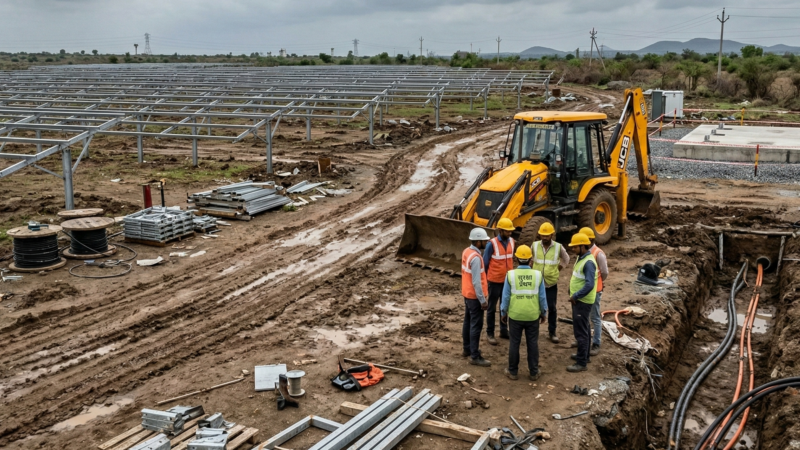
Approvals don�t delay projects�incomplete submissions do. In India, solar projects commonly touch multiple stakeholders: DISCOM, CEIG/Inspectorate, local bodies, land/ROW, and grid authorities (especially where evacuation is involved).
Common approval-related delay triggers:
Missing or inconsistent single-line diagram (SLD) vs as-built vs equipment datasheets
Earthing and protection scheme not aligned with site realities
Net metering / synchronization / charging approvals planned too late
PM-KUSUM documentation not compiled correctly, causing back-and-forth
Missing or inconsistent single-line diagram (SLD) vs as-built vs equipment datasheets
Earthing and protection scheme not aligned with site realities
Net metering / synchronization / charging approvals planned too late
PM-KUSUM documentation not compiled correctly, causing back-and-forth
How a strong EPC prevents it:
�Approval-ready pack� prepared in Week 0 (not Week 8)
One owner per approval (not �everyone is responsible�)
Submission checklist + internal quality gate before the file leaves the EPC office
�Approval-ready pack� prepared in Week 0 (not Week 8)
One owner per approval (not �everyone is responsible�)
Submission checklist + internal quality gate before the file leaves the EPC office
At Innocepts Solar, approvals are treated as a workfront with a schedule, not a paperwork afterthought. That mindset alone prevents many solar project delays.
Mobilization is not �people reached site.� Mobilization is readiness: layout fixed, storage planned, access arranged, temporary power/water, safety plan, and work permits aligned.
What creates delay:
No defined laydown area - materials scattered - handling losses every day
No temporary power - commissioning tools cannot be used on schedule
Boundary/approach issues - trucks can�t enter - unloading becomes a bottleneck
Contractors not synchronized - civil and structure clash
No defined laydown area - materials scattered - handling losses every day
No temporary power - commissioning tools cannot be used on schedule
Boundary/approach issues - trucks can�t enter - unloading becomes a bottleneck
Contractors not synchronized - civil and structure clash
How a strong EPC prevents it:
A �Site Readiness Checklist� signed before mobilization
Micro-plan for Day 1�Day 14: access, storage, crane plan, manpower curve
Mobilization is linked to a weekly look-ahead, not just a date in the master plan
A �Site Readiness Checklist� signed before mobilization
Micro-plan for Day 1�Day 14: access, storage, crane plan, manpower curve
Mobilization is linked to a weekly look-ahead, not just a date in the master plan
This is classic EPC project management solar: you don�t start work until constraints are removed.
You can lose 1�2 hours/day simply because:
Material is stored far from the workfront
Internal roads are not planned
Lifting equipment is undersized or unavailable
Tooling and consumables are not replenished
Material is stored far from the workfront
Internal roads are not planned
Lifting equipment is undersized or unavailable
Tooling and consumables are not replenished
Across a 50�100 person workforce, those small inefficiencies snowball into major solar project delays.
How a strong EPC prevents it:
Workfront-based storage (materials placed where they�ll be installed)
Daily logistics plan: unloading, shifting, lifting windows
Equipment utilization plan (cranes, hydra, forklifts)
Defined �material call-off� rhythm so the site never starves
Workfront-based storage (materials placed where they�ll be installed)
Daily logistics plan: unloading, shifting, lifting windows
Equipment utilization plan (cranes, hydra, forklifts)
Defined �material call-off� rhythm so the site never starves
At Innocepts Solar, logistics is treated like production�measured daily, improved weekly�because it directly impacts on-time solar plant delivery.
Rework is expensive�but more importantly, it�s a schedule killer because it steals time from the critical path.
Typical rework causes:
IFC drawings not frozen before execution
Cable routing not coordinated with civil trenches
Earthing layout not matching soil/site conditions
Wrong component specs ordered due to mismatch in BoQ vs drawings
IFC drawings not frozen before execution
Cable routing not coordinated with civil trenches
Earthing layout not matching soil/site conditions
Wrong component specs ordered due to mismatch in BoQ vs drawings
How a strong EPC prevents it:
Drawing freeze gates (IFC release = formal milestone)
First-article inspection (build one bay/row �perfectly,� then replicate)
Daily QC hold-points and checklists
Joint surveys (civil + electrical + module structure) before excavation
Drawing freeze gates (IFC release = formal milestone)
First-article inspection (build one bay/row �perfectly,� then replicate)
Daily QC hold-points and checklists
Joint surveys (civil + electrical + module structure) before excavation
This is where Innocepts Solar focuses heavily: fewer surprises, fewer reworks, faster progress, and better on-time solar plant delivery.
Long-lead items are not just transformers. In India, delays can come from:
HT panels, protection relays, metering hardware
Specialized cables and terminations
SCADA / communication equipment
Module availability and compliance constraints (e.g., ALMM requirements for many government-linked projects)
HT panels, protection relays, metering hardware
Specialized cables and terminations
SCADA / communication equipment
Module availability and compliance constraints (e.g., ALMM requirements for many government-linked projects)
When these slip, your commissioning window collapses�and solar project delays become inevitable.
How a strong EPC prevents it:
Long-lead register created at bid stage (not after PO)
Vendor manufacturing inspection plan with dispatch readiness checkpoints
Buffer strategy: alternate approved makes, approved substitutions, pre-approved spares
Compliance planned early (documentation, model lists, test certificates)
Long-lead register created at bid stage (not after PO)
Vendor manufacturing inspection plan with dispatch readiness checkpoints
Buffer strategy: alternate approved makes, approved substitutions, pre-approved spares
Compliance planned early (documentation, model lists, test certificates)
Here�s the practical difference between �a schedule� and real EPC project management solar:
1) Critical Path Scheduling with Real Constraints
Not every activity matters equally. The critical path is what decides COD. A strong EPC builds a CPM schedule, then actively protects it.
Reference: PMI � Critical Path Method (CPM)
Reference: PMI � Critical Path Method (CPM)
2) Weekly Look-Ahead Planning + Constraint Removal
Master schedules fail because they don�t remove blockers. Weekly look-ahead planning identifies constraints early and assigns owners to clear them.
Reference: Lean Construction Institute � Last Planner System
3) Disciplined Site Governance
Daily huddle (15 minutes): safety, blockers, today�s top 3 priorities
Weekly review: progress vs plan, constraint log, material status, productivity
Single source of truth: dashboards visible to owner + EPC + contractors
Daily huddle (15 minutes): safety, blockers, today�s top 3 priorities
Weekly review: progress vs plan, constraint log, material status, productivity
Single source of truth: dashboards visible to owner + EPC + contractors
At Innocepts Solar, this governance cadence is non-negotiable because it directly drives on-time solar plant delivery�especially in multi-stakeholder projects like PM-KUSUM.
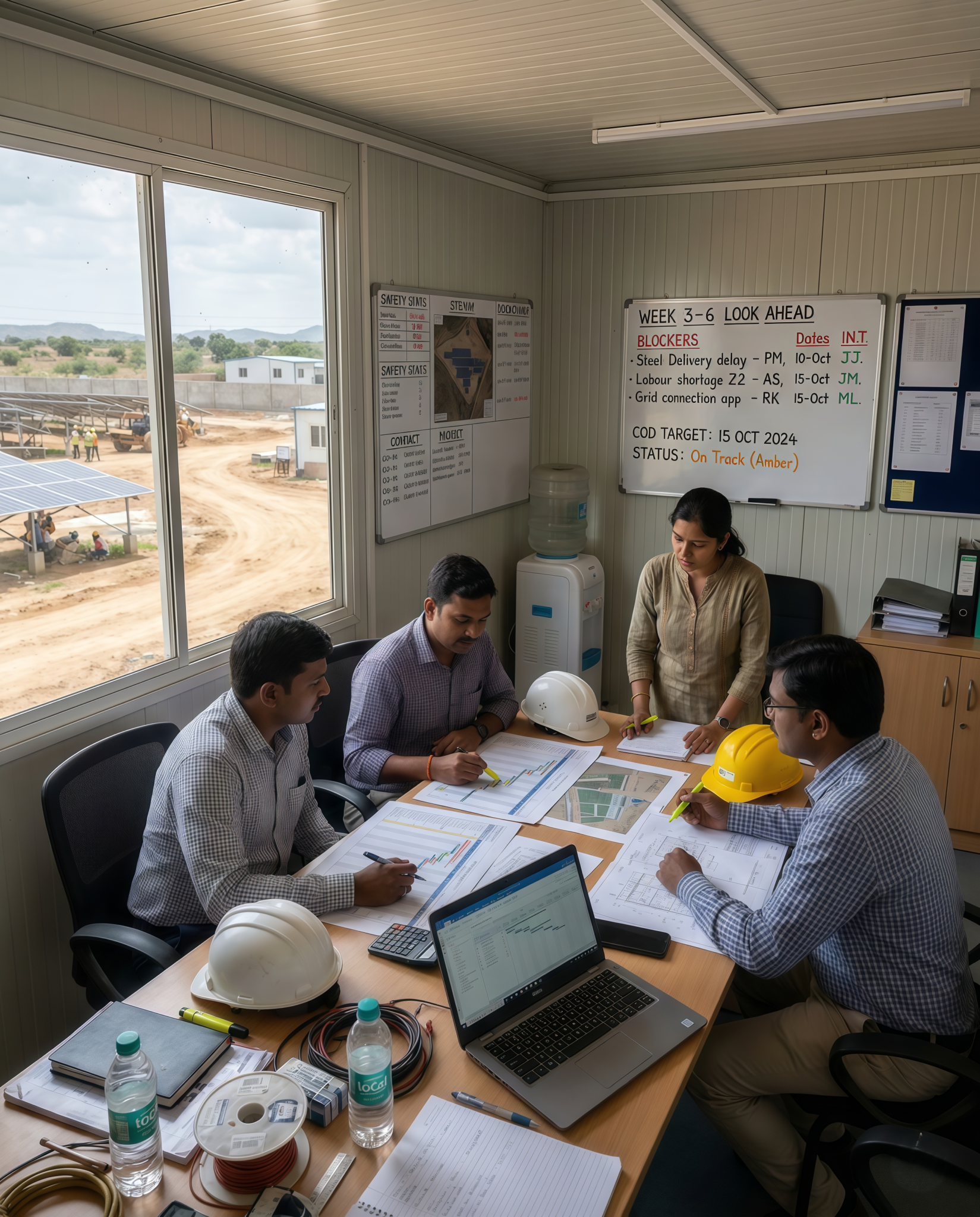
Manpower idle in Week 1
If you want fewer solar project delays, demand these artifacts before construction:
CPM schedule with critical path highlighted
3�6 week look-ahead template + constraint log format
Long-lead register (transformer, HT, modules, SCADA, cables)
Site logistics plan (roads, laydown, storage, cranes)
IFC drawing release plan + revision control
QA/QC checklists + commissioning plan
Single reporting dashboard with weekly progress metrics
CPM schedule with critical path highlighted
3�6 week look-ahead template + constraint log format
Long-lead register (transformer, HT, modules, SCADA, cables)
Site logistics plan (roads, laydown, storage, cranes)
IFC drawing release plan + revision control
QA/QC checklists + commissioning plan
Single reporting dashboard with weekly progress metrics
If your EPC cannot show these clearly, on-time solar plant delivery becomes a gamble.
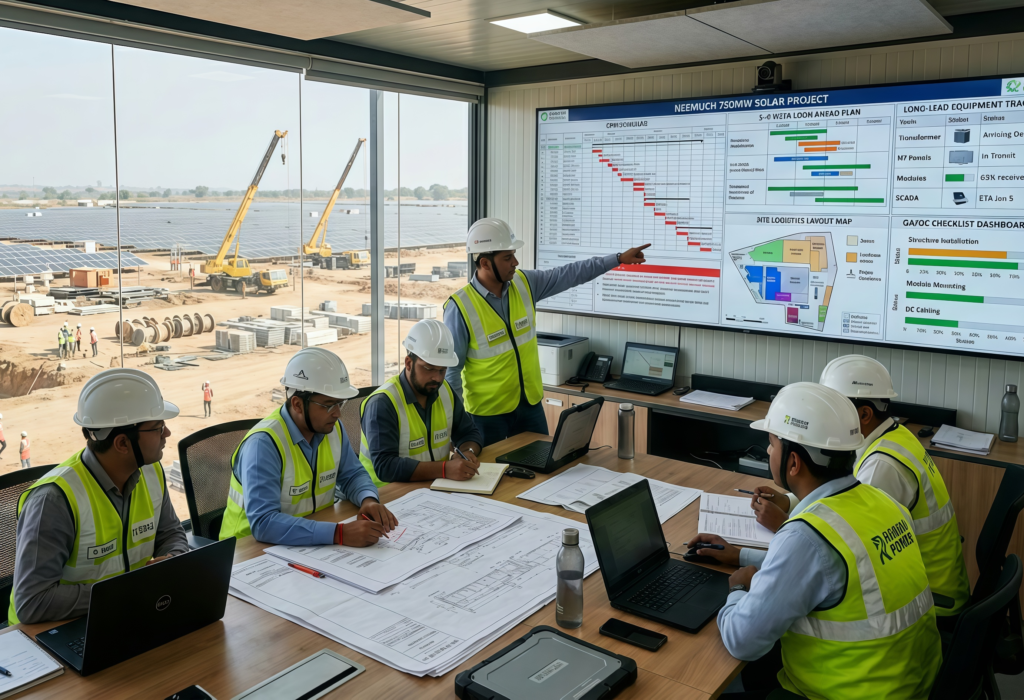
A 60-day slip is rarely �bad luck.� It�s usually weak planning, late constraint removal, and inconsistent site governance. The fix is simple�but not easy:
Protect the critical path
Plan weekly (not monthly)
Remove constraints early
Govern the site with discipline
Protect the critical path
Plan weekly (not monthly)
Remove constraints early
Govern the site with discipline
That is how Innocepts Solar executes projects with fewer surprises and stronger confidence in on-time solar plant delivery�whether it�s industrial rooftop, ground-mount, or PM-KUSUM.
If you want, share your project type (MW size, state, grid/PM-KUSUM, target COD). Innocepts Solar can help you map the critical path and identify the top 10 constraints before they cost you weeks.
Approvals, slow mobilization, site logistics issues, rework due to design/QC gaps, and delayed long-lead items are the most frequent causes of solar project delays.
By using critical path scheduling, weekly look-ahead planning, constraint removal, and strict site governance to protect on-time solar plant delivery.
A 3�6 week forward plan that identifies upcoming tasks, checks readiness, and removes blockers before work starts�core to EPC project management solar.
Most delays happen due to incomplete submissions, unclear ownership, and missing documentation�not because authorities �sit on files.
Common long-leads include transformers, HT panels, protection relays, SCADA, specialized cables, and module compliance documentation.
Ask the EPC for CPM schedule, look-ahead plan, long-lead tracker, logistics plan, IFC drawing controls, and a weekly governance rhythm.
Yes. Rework steals time from critical activities and creates cascading delays�one of the most underestimated reasons for solar project delays.
Laydown areas, internal roads, unloading/lifting plan, workfront storage, movement routes, and tool/consumable replenishment.
Immediately after technical freeze�long-lead planning should begin at bid stage for reliable on-time solar plant delivery.
Innocepts Solar uses weekly look-ahead planning, a constraint log with owners and dates, and escalations in weekly reviews.
Even smaller plants benefit�CPM helps identify tasks that can�t slip without impacting COD, strengthening EPC project management solar.
Planned vs actual progress, critical path status, constraints aging, material delivery status, rework rate, and safety stats.
Documentation gaps, approval misalignment, site readiness, and procurement timing�especially when responsibilities are unclear.
Create a recovery plan: re-baseline critical path, unblock constraints, fast-track long-leads, and enforce daily/weekly governance.
If there�s no credible recovery plan, no transparent reporting, repeated rework, and consistent long-lead slippage without mitigation.